Gough Whitlam – The Radical and The Dismissed.

Politics and hypocrisy go hand in hand. They are often unrecognisable from each other.  In Parliament we see it often. The start of Question Time often begins with a statement from the Prime Minister, announcing that Australia is engaging in a war effort here or there, or his condolences at the passing of a statured individual. The opposition then rise to associate themselves with the statement. The Opposition Leader in a soft, tender tone evocates support, and explains the reasoning. It is civil, mature and most importantly reassuring to the public.

Then the Opposition Leader concludes his statement, the speaker asks if there are any questions without notice and up jumps the Leader of the Opposition. In a loud booming voice, asks a loaded question with words like ‘rotten, unfair, lie’. The Government ministers interject, the opposition members respond, there is a ‘cacophony’ of noise.

The moment of national unity has passed, the partisan divide of politics has returned.

The hypocrisy of politics on full-frontal display.

Today, the 21st of October, 2014, things are different. Question Time and estimates have been suspended; the flag at Parliament house is flying at half-maste.  Maturity has returned to Australian politics. The reason being, former Prime Minster Gough Whitlam has died, aged 98.

He was a towering figure in Australian Political History. Ascending to the top after 23 consecutive years of careful, efficient Liberal rule, Whitlam proved to be a transformative, radical leader. Impatient to implement his vision for the country, Whitlam did not accede to the conventional political wisdom of his predecessors, gradual reform and consultation, rather it was more ‘crash through or crash’.  Rather than wait for a Cabinet be assigned to him by caucus before being sworn in as Prime Minster, he had the Governor General swear him and Deputy Lance Barnard in. Together they held all 27 ministries.

The agenda was radical at the least. It included ending conscription (Australia’s effort in Vietnam being virtually over), the final abolishment of the White Australia Policy (a process begun in 1967 by Harold Holt), the introduction of free universities, introduction of Universal Health Care (Medibank later Medicare). On the international stage Australia recognised Communist China, Whitlam having presciently visited there in 1971, several months before US President Richard Nixon. Australia’s position was altered to supporting sanctions against Apartheid.  The Honours system was replaced by the Order of Australia. The national anthem became Advance Australia Fair. Infrastructure funding was increased.

It would not be easy. The 1972 election victory was not large, a majority of just 9. The Liberals maintained a majority in the Senate and blocked several of the Government bills including the introduction of Medibank. This lead to a double dissolution in 1974 that Whitlam would win but with a reduced majority in the House (5 seats), and be deadlocked with the Liberals in the Senate.

Throughout this process, the world economy changed. Inflation and unemployment increased. The economy went into recession. The Whitlam government was accused of ignoring the problem. The Government was plagued by scandal after scandal, culminating in the Loans Affair. One of the more sensational events of the Whitlam government, it became public knowledge that the Government in an attempt to raise some $4 billion ($1 trillion today) to fund several energy projects, sought a loan from Arab nations through an intermediary associated with Saddam Hussein and the Ba’ath party. It caused considerable damage to the Government’s reputation.

The chaos around the Government was used as justification by the Liberal Opposition lead by Malcolm Fraser, to block supply of the 1975 budget. The Liberals at this stage had a majority in the Senate for reasons that are too detailed to go into right now. They blocked supply and demanded an election. An election Whitlam was unwilling to provide owing to the unpopularity of the Government and their slim majority in the House.

Eventually,  the Governor General  Sir John Kerr broke the impasse and sensationally sacked Whitlam as Prime Minister, installing Fraser as caretaker on the condition he call an election. It’s considered today a constitutional crisis and remains one of the most controversial decisions in Australian political history. In that moment, the ever witty Whitlam uttered his most famous words. ‘Well may we say “God save the Queen”, because nothing will save the Governor-General”.

The subsequent 1975 election was divisive and passionate with rallies attracting thousands. Despite the intensity it was obvious that mainstream Australia had turned against Whitlam.  Fraser won in an absolute Landslide, a 55 seat majority, the biggest majority in Australian Federal history.

Whitlam didn’t handle the politics of the time well, and many events colluded against him to which he didn’t react appropriately, notably the economy. However, his legacy is great. He managed to re-unite the Labor party, won two elections, the first Labor Prime Minister to do so. In his time as Prime Minister he sought to modernise the country and significantly expanded the role of the Federal Government.

In a statement today, Prime Minister Tony Abbott said Whitlam was ‘A giant of his time…in so many ways, larger than life’.  Despite the obvious differences between Whitlam and Abbott, none more symbolic than Abbott’s partial re-introduction of the Honours system, Abbott has observed protocol out of respect for somebody as important as Whitlam. It is Australian politics at its best, most mature and its most hypocritical, but that’s politics after all.

RIP Gough Whitlam 1916 – 2014.
Decision making – AFL style. Nothing makes sense.

There are no ifs or buts about it. This is a disgraceful on the run decision made for no legimiate reason.

The AFL announced yesterday that the Sydney Swans would be banned from trading players into the club unless they forfeited their COLA now, as opposed to 2017 when it will be phased out.

Why?

Well that’s a good question.

No body knows.

The AFL didn’t provide anything resembling a reason.

Had the Swans cheated the salary cap? Was their draft tampering? An ASADA investigation perhaps?

No. Nothing. Zilch.

Basically, the Sydney Swans have been punished because they followed the AFL’s rules. That’s right. The Swans may have supported the COLA, but it was an AFL directive. The AFL has punished the Swans because they’ve been good at what they do. They’ve punished the Swans because a few bigwigs with growing stomachs and receding hairlines have been complaining about it. Short of an actual reason from the AFL that is the only conclusion that one can arrive at.

I hesitate to mention his name but one Edward from Collingwood is at the heart of this. He complained about Brisbane and now it was Syndey. I wonder, will he complain about Hawthorn recruiting James Frawley after BACK-TO-BACK premierships? Will the media run the story filled with anonymous quotes from other club chairman’s describing it as a ‘joke’. Probably not.

This isn’t about the COLA anymore. The AFL is right to remove it. The public couldn’t understand why somebody like Lance Franklin or Kurt Tippet would need 9.8% on top of the considerable amount they were earning. That argument made sense, and despite Sydney’s repeated claims of its necessity, the AFL announced its removal in 2017.

This is what makes Thursday’s announcement all the more confusing. If the AFL wanted the COLA gone immediately, why not do so. Why disadvantage the club?

Why punish them for lean recruiting. Yes they recruited Lance Franklin but whom did they lose in the process? Jude Bolton, Shane Mumford, Jed Lamb, Andrejs Everitt, Tony Armstrong & Martin Mattner. The AFL should be aware of this.

It’s another incomprehensible decision from an AFL commission who don’t seem able to make decisions unless they are incomprehensible. Most infamously in 2013 when Melbourne were investigated for tanking, they were fined half a million dollars, but they AFL was adamant they didn’t cheat. Did I mention, they didn’t bother defining tanking?

In the past when the AFL made decisions like these, Andrew Demetriou was blamed. He isn’t there anymore. The Commission has become too bureaucratic. There isn’t enough transparency. Not enough explanation. They’ve become a political party in Government, only there are not elections. The AFL should heed the lessons of history. The VFL was a breakaway competition of clubs unhappy with the VFA. If the public is unsatisfied, they will find something else.

James Hird Must Go and Everyone Knows It

The football public knows, and has known now for a long time, that James Hird cannot continue as coach of the Essendon Football Club. Yet on Sunday night the board released a statement declaring Hird remains the coach of the club.
Why, when it is so clear to the average punter that Hird has to go, has the club dug its heels deep into the ground?
The issue is complex no doubt.
ASADA and the Federal Government deserve blame for this. They are the ones who created this highly emotional and difficult atmosphere. Their press conference in February last year was exaggerated, melodramatic and ultimately counterproductive.
The public expected grand revelations of cheating. The reality was slightly tamer, but no less serious.
Essendon ran a supplements programme. Its own internal investigation was highly critical of the programme ran. It was poorly documented, poorly organised, and poorly monitored.
The players have been placed in the intolerable position of facing bans by ASADA. More seriously, the club is not in a position to clarify exactly what it is the players took. Forget about the legality, was it safe?
If the first role of a coach is to achieve success for their football club, their second is to protect their players. On this count Hird and the Essendon Football Club have failed miserably. The club’s duty of care to its players has been fundamentally breached. The CEO is gone, the chairman is gone, and the coach must now go.
By continuing to fight on, Hird has allowed his once ‘golden boy’ reputation to be destroyed. The football public now sees him as selfish, unwilling to acknowledge his mistakes, or offer an apology. Perhaps had he offered these concessions from the start, we would be more forgiving.
He, and for the most part Essendon, have behaved as if this all a grand conspiracy against them. As if the AFL managed to convince ASADA and the Federal Government to launch this inquiry simply in order to remove Hird from his position as coach.
It is irrational, illogical and wrong.
Even when Essendon challenged the legality of the investigation, the court found against them. Hird is challenging, claiming that it is in the best interests of the club and the players. One has to wonder how it is?
In the NRL, Cronulla cooperated to a greater extent than Essendon and the investigation is over. The players missed three games. It was a joke that angered the footballing public, but it was great for the players. Shane Flanagan is on the verge of being returned to his position as coach. That is what Essendon should be working towards.
But it continues to drag on.
It has cost Essendon millions. Fines, pay-outs, legal fees. A weaker club would have been destroyed by it.
The club has to move on from this. Mark Thompson is the man to take them there. He is a two-time premiership winning coach who has re-discovered his passion for coaching. They have a playing group that should be pushing for a top-four finish. But their last two seasons have essentially been wasted by this ASADA investigation.
They have to move on, the AFL wants to move on, and so do the other clubs.
So how is it that James Hird remains the coach of Essendon when he so obviously shouldn’t be?

The Rudd-Gillard Years According to Paul Kelly

Paul Kelly is the editor-at-large at the Australian newspaper. I don’t really know what that means exactly, sounds like a position made up just to make some really good journo feel good about themselves, but I digress. He is also the author of several highly regarded books on different periods in modern Australian political history.

In many ways Kelly is the pre-eminent political commentator in the country. His opinions are highly regarded. His take on issues is gleamed from more than forty years of experience in the industry. He is respected across the political divide. Although these days more so on the right than on the left, who see Kelly as a cultural warrior against them.

Nonetheless I find Kelly a brilliant and informative writer. His book the March of Patriots about Paul Keating and John Howard was brilliant. In it he argued that there was more that unified than divided Howard and Keating. Describing them as patriots who although disagreeing on cultural/tribal issues, their economic policies were mostly in sync.

His analysis of Keating is fascinating but already done to death; there is greater documentation and analysis of Labor politicians than their Liberal counterparts. Kelly’s analysis is distinguished by his detailed account of the early Howard years. It is fair, by no means uncritical, but provides a centre ground from the right wing criticisms that Howard engaged in middle-class welfare, and left wing criticism that he was a Neo-Liberal conservative determined to return Australia to the 1950s.

His analysis explained the reasons why Howard did what he did and left the reader to decide on them. He described the Howard government as misunderstood and went about clearing up misconceptions. I can’t explain the effect that had on me as a reader. Howard was elevated greatly in my eyes, and remains high in my opinions, as he is with a large number of Australians. In fact many of us probably wish we hadn’t kicked him out in the first place, but hindsight is a wonderful thing.

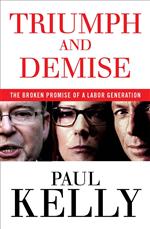
His new book Triumph and Demise examines the six years of Labor under Kevin Rudd, Julia Gillard and then Kevin Rudd again. He describes it as the ‘Broken Promise of a Labor generation’.

Kelly writes with such intensity, it often feels like a thriller. It is fast-paced, never dull, but often depressing. Kelly lays bare the incompetence of Rudd and Gillard as leader. From the chaos to process that Rudd created, to the poor political judgements of Julia Gillard. He also details how Abbott rose to the leadership of the Liberals by accident and the momentous nature of his rise.

There is much of contention in the Rudd-Gillard years. Kelly although presenting his opinions strongly, permits the opinions of a great deal others to permeate the story. They differ greatly, ensuring that on a number of issues there is no uniform historical judgement. Then again, Labor lost office not a year ago. In time this may change.

Kelly’s works often shape politics around personality. He argues that the differences between Rudd and Gillard weren’t on policy, but rather on personality. Rudd was religious, married, conservative socially. Gillard was an atheist, unmarried, childless. They were very different people. Rudd was an outsider who won the support of his party through his popularity with the people. Gillard was an insider, with a strong union background that had a strong base of support in the party. Together they were formidable. Apart they had severe defects.

He juxtaposes this with the leadership showdown between Abbott and Malcolm Turnbull. This was about a genuine policy difference. Turnbull wanting to support the ETS, a policy he believed in and had advocated. Abbott constantly changing his mind, before finally deciding to oppose the ETS, when it became obvious the conservative side of politics was firmly against it and that the Coalition was under threat of being ripped apart by it. The Nationals would not have supported it. Abbott won the dispute and the rest, as they say, is history.

Kelly forcefully argues that the removal of Rudd as Prime Minister was the ‘death warrant’ for Labor. By removing Rudd and then never explaining it to a public that was still largely unaware of the archaic nature of his leadership, Gillard was unable to recover.

I don’t necessarily agree with that. Although the removal provided many challenges, Gillard could have recovered from them had she not made several catastrophic errors in the 12 months following her ascension.

In my view, it was Gillard’s decision to enter into an agreement with the Greens that signed the death warrant for Labor. It forced her to back-flip on an election promise and placed her legitimacy into question once again.

One of the more sensational revelations comes from Gillard, who claims that in the lead up to the leadership challenge she firmed the view that Rudd was mentally unable to do the job, claiming he was depressed.

A large portion of the book is dedicated to discussing the political culture in the country. Kelly is rather pessimistic about it, believing it beholden to focus and interest groups, incapable of reform and susceptible to scare campaigns (GST, Work Choices, Carbon Tax). He is unsure if Abbott is capable of arresting this decline, and the early signs aren’t encouraging (the budget).

He also examines the existential challenges facing the Labor party. They are losing their working class base to the Liberals, and losing their progressive base to the Greens. Finding it very difficult to maintain a balance between the two. He doesn’t say they can’t survive into the future, but recommends they break union ties and push a certain new identity into the future. It is too confused.

The story Kelly writes is brilliant. At times he is prone to hyperbole, which can be a turn off, but adds to the readability of the work. A lot is omitted from this review. However, if you want to understand the Rudd-Gillard-Rudd years, how they rose, and why they fell, this is the book.

The Tragedy of the Mining Tax

Paul Kelly’s account, in his excellent new book Triumph and Demise, of how Labor bundled its mining tax makes for excruciating reading. It highlights the chaos, dysfunction and incompetence of the Rudd government that a tax, intended on spreading the benefits of the mining boom, could be so unpopular as to destroy a Prime Minister. That is exactly what happened.

At the heart of its failure was the lack of consultation between the Government and mining companies. Prime Minister Kevin Rudd and Treasurer Wayne Swan thought they had a political winner on their hands with a mining tax. They believed it was capable of coercing the mining companies into accepting a deal with the Government on Labor’s terms. This would require public support for the tax. It was not forthcoming.

Resources Minister Martin Ferguson reveals that the mining companies were not opposed to the principle of a mining tax, however they expected to be consulted.
Rudd and Swan did authorise Ferguson to tell the mining companies that the Government would be consultative. They would not stay true to their word.

Kelly argues that Labor had no intention of consulting them, even excluding Ferguson from the process. It was a classic example of Labor’s use of style over substance.

Kelly claims that they wanted a fight. Rudd, having shelved the ETS, and accused of lacking conviction, wanted to show he had backbone. However, Labor was not prepared for the angry opposition it would instigate.

The mining companies initiated at $25 million campaign opposing the tax. They argued it would severely hurt the industry, jobs, growth and the economy. No doubt they exaggerated these claims but as Kelly states, the mining tax was essentially a 40% new tax on our most important industry, how could it not hurt the economy?

Beneath the economics was the sentiment amongst mining companies that they were being treated with contempt, despite their consideration of having contributed significantly to Australian society. For example, BHP Billiton paid more tax than any other company in the country. Andrew Forrest was working with the government on a programme to aid Aboriginal children.

From the Government’s perspective, this was a David and Goliath struggle to ensure that regular Australians received their fair share. They would not be dictated to by vested interests and big business that selfishly wanted to rob many Australians of the benefits of a once in a generation mining boom.

Unfortunately for the Government, public sentiment was with the miners. According to Newspoll only 28% of the public supported the tax with 48% opposed to it.

For the opposition, it was a gift. Rudd had months earlier shelved the ETS as Tony Abbott’s campaign against the ‘great new tax on everything’ gained traction. Now he was announcing another ‘great new tax’ this time on Australia’s most important industry. Abbott went to town on the issue, as did the rest of the Liberals and Nationals, who couldn’t believe their luck.

To top it all off, Rudd and Swan failed to consult with the states, which technically owned the mining resources. They had been left out of the details and feared losing their royalties. They too would join in the opposition to the tax.

Labor was fighting a war on three fronts, with public sentiment firmly against them. It wasn’t that the public opposed having a mining tax but rather opposed the truly archaic process of its implementation. It fed into the growing narrative of chaos and dysfunction surrounding Rudd and his government.

Kelly argues that the mining tax would be the dagger in the heart of Rudd’s leadership. It was the moment that Rudd lost the support of a large part of his caucus, notably his deputy Prime Minister. The rest, as they say, is history.

Nick Cater Sums up Asylum Seeker Policy to Perfection

Australia is one of fewer than two dozen countries in the world that sets aside a portion of its annual migrant intake for humanitarian aims, and the size of the program makes it one of the most generous.

Yet the program, operated in close consultation with the UNHCR, has been effectively frozen for the past few years as officials process many thousands of applications from people arriving by boat. Meanwhile, millions who have been displaced in the Middle East, notably in Syria, and in Africa, have no hope of finding shelter in Australia unless they are able and willing to pay a large entry fee to criminal gangs indifferent to the loss of human life.

The fraudulent claim that an open borders policy is “compassionate” has been exposed. It is time we asked for our word back.

Eddie vs Priddy

In the war of attrition between football clubs, the fight off the field is just as important, if not more, than the fight on it. Middle-aged men with receding hairlines and growing stomachs explode onto our screens and radios from time to time and remind us of this never ending war. Sometimes we forget its existence, our focus is on the football, but sometimes the football isn’t all that exciting compared to an all in administrative brawl. It’s not the same as an on-field brawl of course, no punches are thrown….hang on.

This week’s off-field brawl is between Collingwood President Eddie ‘Everywhere’ McGuire and Sydney Swans President Andrew ‘Is this thing on?’ Pridham. It all started in a rather ‘petty’ way you can say. Sydney coach John Longmire rejected an offer to be assistant coach of the International Rules team later this year because he didn’t want to work with McGuire, the team manager. McGuire thought it was all rather ‘petty’ and said he has put aside personal interest for the national team, so should John.

Well Sydney President Pridham didn’t let that one pass.

“It is a crazy world when Eddie McGuire is not content with just running the AFL, he’s now protecting our national interest. I can’t help but see a comparison between Eddie’s patriotism and protection of the national interest and the fact Clive Palmer is currently dominating the political agenda in Australia. I’ll leave you with that to think about.”

The Clive Palmer analogy is rather hilarious. It might the funniest thing said by any club President since Jeff Kennett promised no-body would hear from him as President. Andrew Pridham had made his point and found himself in the limelight. Eddie seethed and returned serve as only Eddie could…with utter rubbish.

“They have wound up Caroline Wilson to start running this campaign that I am the most powerful bloke in football and have too much to say and all the rest of it. I haven’t been powerful enough otherwise we may not be where we should be at the moment.”

It’s all a grand conspiracy you see.

“They are the greatest protectors of their self interest of any organisation God has put breath into,”

Let’s pause and reflect on that comment for a moment. Eddie McGuire is complaining about an organisation protecting itself self-interest. Oh the hypocrisy!

“These blokes haven’t developed anything up there … that’s why Jarrod Witts is playing first ruck for Collingwood, that’s why Lenny Hayes has been a superstar down at St Kilda.”

Errr……Jarrad McVeigh, Brandon Jack, Kieran Jack, Lewis Roberts Thompson, Harry Cunnigham, Craig Bird, Dane Rampe. All NSW developed players, but why let the facts get in the way of a good story.

“They have let blokes march out of the joint because they have had no interest ’cause they open the chequebook up and go after everyone. They have been doing it since Gerard Healy went up there.”

He’s right Sydney have signed some real big names in the past 25 years. Craig Bolton, Martin Mattner, Ben McGlynn, Nick Davis, Josh Kennedy, all household names before they came to Sydney! HA!! 

Another unfinished chapter in the never ending Off-Field brawling chronicles. May they never end! . 

Politics in crisis and a nation in denial? According to Paul Kelly it is.

An absolutely brilliant article in the Australian today from Paul Kelly.

“THE trajectory of Australia’s relative decline now seems set with the nation in denial of its economic challenges and suffering a malaise in its political decision-making — signalling that a country that cannot recognise its problems is far from finding their solution.”

Bang!

It gets better.

“Any nation that has lost the art of collective self-improvement has stepped on to the escalator of decline. Australia is on that escalator. Its politics are so noisy, egotistical, destructive and consumed by self-interest that it has missed where the escalator is heading.”

Who is to blame?

“The troubles of the Rudd-Gillard era, usually attributed to their fierce leadership rivalry, can only be grasped in the context of the malaise within the political system. The omens suggest this might only deepen under the Abbott prime ministership.

The institutional question arising from Tony Abbott’s policies is whether a reforming prime minister can succeed any more in this country given the decisive shift in the system and culture against reform. The last three prime ministers were destroyed over management of their reform agendas: John Howard on Work Choices, Rudd and Gillard on a mix of climate change, mining tax and fiscal policy.

Recent history is defined by the triumph of the negative and fatal blunders on the part of agents for changes, witness the ACTU campaign against Work Choices, the mining industry campaign against the mining tax, the Abbott-led destruction of carbon pricing and, most recently, the undermining of the Abbott-Hockey budget on the crusade of fairness.”

Basically both sides are to blame. 

Also, the media

“During the reform age, roughly 1983 to 2003, the media was pivotal in backing national interest policies but that age is passing. It is replaced by new media values that mirror the fashionable narcissism and find national interest debates as quaint and irrelevant.”

Disappointingly he provides no solution. 

“Australia’s prosperity is living on borrowed time, courtesy of past reforms and the China boom. There is a silly, contested debate about whether Australia faces an economic crisis. There is no doubt, however, that Australia is undergoing a crisis of its political system.”

Nonetheless, it is one might rant against the current political landscape and with Clive Palmer proving to be as erratic as was envisaged, expect many to shake their heads in furious agreement with Mr. Kelly. 


Dear Leader: North Korea’s Senior Propagandist Exposes Shocking Truths Behind The Regime

The title is slightly misleading. Jang Jin-Sung was one of the senior North Korean propagandists, not the most senior.  However it seems oddly appropriate for a book about North Korea to be misleading in its title.

As a senior propagandist he writes poems about the Dear Leader, under the pseudonym of a South Korean poet espousing the virtues of the North Korean state against the ‘tyranny’ of the South state which until 1987 was a military dictatorship.

Jin-Sung’s rise through the ranks, convinces him that almost everything he has been taught to believe was false. He becomes increasingly disillusioned with the regime. In 2004, he decides to flee the state with a friend, when authorities find that he has been sharing private Western literature with those who don’t have the clearance to view such content.

The books details his journey from North Korea into China and eventually into South Korea. It is at times a thriller, other times a political history.

It is filled with shocking and detailed information about the Kim family regime. It is almost impossible to go into detail in a review because any subtraction in detail would detract from the powerfully woven revelations about the state.

Most shocking for me was Jin-Sung’s return to the province he grew up in. Set during the North Korean famine of the 90’s, the province had been reduced to a place of poverty and death. In fact the people so poor and death so common, local party officials were paying desperately poor people to remove the bodies of dead beggars from the streets.

The plight of a local family that Jin-Sung knew as a child was heartbreaking. Living off the residue produced when rice is boiled and saving the rice for as long as possible.

Public trials are a farce. Accusations are read out by army personnel, judgements given immediately and death by the firing squad performed publicly in the market for all to see. Not that anybody can afford anything sold at the market.

It is impossible to read these sections passively.

As as a Western reader, i’m most shocked by the extent to which North Korea controls the thoughts and actions of its people. I have difficulty comprehending it.

The cult of personality which surrounds the Dear Leader is nothing short of incredible.

When Jin-Sung meets Dear Leader Kim Jong-il he is shocked to see that his feet swell. He had been taught that the Dear Leader was a semi-god. Did not get sick or even use the toilet. He was the perfection that all North Korean’s must aspire to. It is here that Jin-Sung begins to question the truth of his regime.

North Korean’s must feel an un-abiding  love for the Dear Leader that overrides their love for any person or any object. When a woman comes to his rescue in China, he is shocked when she explains to him what a ‘fiancé’ is and describes him as her ‘honey’ or ‘love’. He is stunned to hear somebody publicly acknowledge her love for another person and not the Dear Leader.

There are many more powerful stories that permeate this book. The kidnapping of Japanese and South Korean children so they can be raised sympathetic to the regime. Mother’s selling their children, because as they will most likely die from starvation, at least there is somebody to look after her children.

While media coverage focuses on North Korean rhetoric, its power struggles and Kim Jong-Un’s haircut, this book refocuses our attention to the horror and desolation the North Korean people suffer at the hands of its regime.